 |
|
|

University of Washington
Department of Architecture, Spring 2001
[Computational] Geometry in Islamic Architecture
Instructor: Mamoun Sakkal, PhD
Muqarnas, part 1: The basics.
Muqarnas is the Arabic word that describes a traditional element unique to Islamic architecture, in which small nich-like components are combined with each other in successive layers to enclose a space and produce surfaces rich in three-dimensional geometric compositions.
Fig. 1. Parts of the Muqarnas block |
I call these components "Muqarnas Blocks." These blocks change the surface of a space enclosure in a three-dim en ti on al way due to their unique geometry. Although they can take many different variations in shape, it is possible to simplify the typical block into basic parts that represent its geometrical function as shown in fig. 1. This model is produced in FormWriter, a 3D program developed at the University of Washington Architecure school's computer lab. I used the triangle primitive, and combined the triangles to form pyramids and prisms. All images on this website were produced by importing the models created in FormWriter to Infini-D software for final rendering. |

Fig. 2. Muqarnas blocks families |
The blocks used in a composition are related to each other in precise geometry. In regular compositions, the angle of the block's base is increased by increments of one full angle in each successive block. For example, the 45 degrees family of muqarnas blocks has three blocks with 45, 90, and 135 degrees as shown in figure 2 from left to right.
|



|
|
|
|
Fig. 3. Muqarnas blocks interior surface variations Each block can have different interior surface configuration without affecting the basic geometry of the block. The FormWriter program that generates the blocks allows one to obtain all blocks in a family by defining only one variable, the smallest angle in the family, and to obtain all interior surface variations by changing another variable. Fig. 3 shows the different variations of interior surfaces in the 45 degrees family if we change the shape of the middle base of each block in regular increments of 11degrees 15 seconds (45/4). |
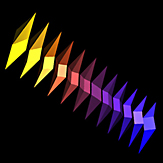
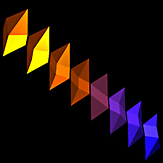

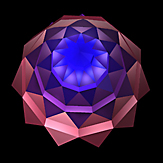
Fig. 4. Muqarnas dome |
The members of each family of muqarnas blocks will fit with each other to completely enclose space, usually in a dome-like structure. The smaller blocks are at the top of the dome. In each successive layer, the angle of the blocks is increased. Model of the 30 degrees family dome is shown in fig. 4. The above program will produce all possible families of muqarnas blocks simply by entring the value of the smallest angle in the family. |
The blocks are also composed with each other according to rules that changed from region to region. In part two I show 2 related examples from Turkey and Armenia.

Revised 05/23/2016